5 Risk Management Rules Every Futures Trader Should Follow
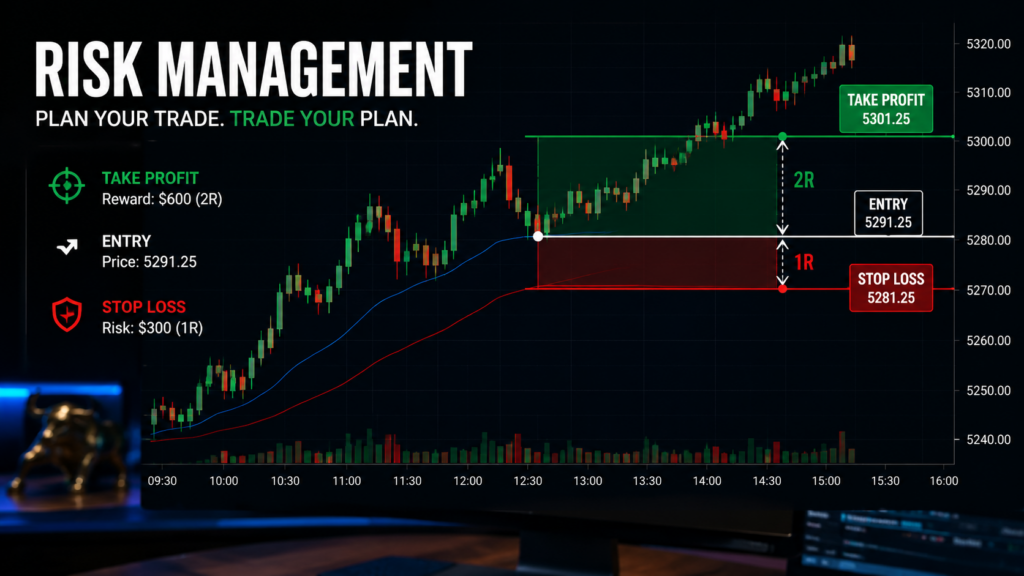
Futures trader risk management is one of the most important skills a trader can develop.
Most traders spend their time searching for the perfect strategy, indicator, or entry signal. While strategy matters, long-term success in futures trading depends far more on risk management than finding the next winning setup.
Over the years, I’ve learned that protecting capital is the foundation of consistency. These are five risk management rules that every futures trader should understand and apply.
1. Never Risk More Than You Can Afford To Lose
The first goal of trading is survival.
Many new traders focus entirely on potential profits while ignoring potential losses. Every trade carries risk, and protecting your account must always come before making money.
Before entering any trade, determine exactly how much you are willing to lose if the trade fails. If the risk exceeds your comfort level, reduce your position size or skip the trade entirely.
A trader who survives losing streaks can continue improving. A trader who blows up an account must start over.
2. Always Use A Stop Loss
A stop loss is not optional.
Markets can move quickly, and unexpected events can create sharp price swings. A stop loss defines your maximum acceptable loss before you enter the trade.
Using a stop loss removes emotional decision-making and helps maintain discipline during volatile conditions.
The best traders are not the ones who avoid losses. They are the ones who control losses.
3. Keep Position Size Consistent
One of the biggest mistakes traders make is increasing position size after a winning streak or attempting to recover losses after a bad day.
Consistency is critical.
Position sizing should be based on account size, risk tolerance, and trading plan—not emotions.
A consistent position size allows traders to evaluate strategy performance objectively while minimizing unnecessary account volatility.
4. Focus On Risk-To-Reward
Winning percentage alone does not determine profitability.
A trader can be profitable with a relatively low win rate if winning trades are significantly larger than losing trades.
Before entering a trade, ask yourself:
- How much am I risking?
- How much am I realistically expecting to make?
Many traders look for opportunities where the potential reward is at least two times greater than the potential risk.
Good risk-to-reward ratios help offset inevitable losing trades.
5. Protect Your Daily Loss Limit
Every trader experiences losing days.
Professional traders understand that some days are simply not their day. Rather than forcing trades and increasing risk, they stop trading when a predetermined loss limit is reached.
A daily loss limit protects both capital and mindset.
When emotions begin to take over, discipline often disappears. Having a hard stop for the day prevents small losses from becoming major setbacks.
Final Thoughts
Risk management may not be exciting, but it is one of the most important skills a trader can develop.
Profitable traders understand that preserving capital comes first. Consistent risk management allows traders to survive difficult periods, learn from mistakes, and continue improving over time.
Remember: trading is not about hitting home runs. It is about protecting capital, managing risk, and staying in the game long enough to develop consistency.
Continue Learning
Want to learn more about my trading journey and lessons learned in the markets? Explore my Trading Journal and follow my progress as I work toward becoming a consistently profitable futures trader.