Why I Trade The MES Instead Of The ES
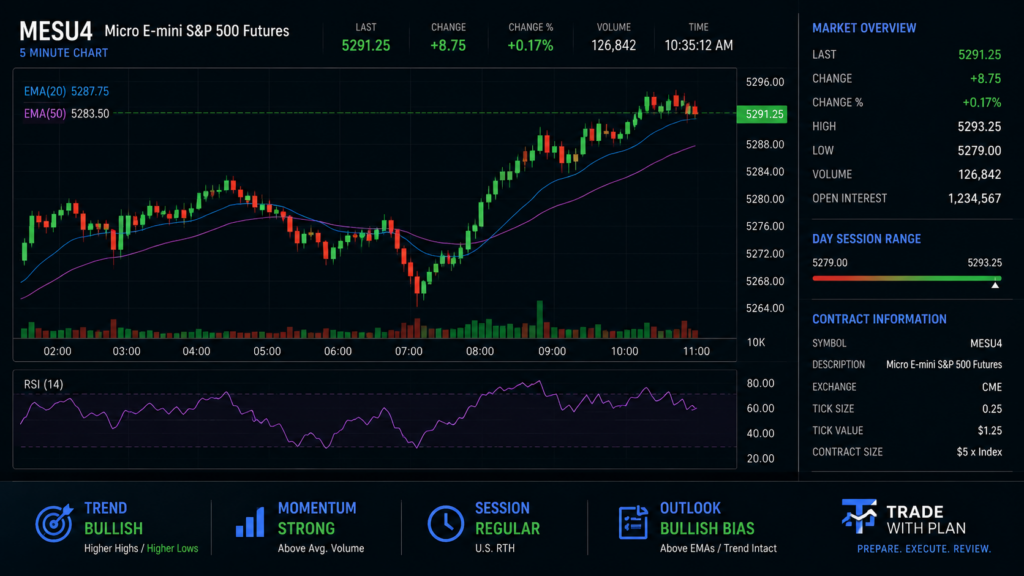
MES vs ES: What’s The Difference?
MES vs ES is one of the most common questions new futures traders ask. When I first started trading, I had to decide whether the ES or the MES was the better choice for my trading style and account size.
When I first started trading, I was naturally drawn to the ES because it offered larger profit potential. Like many beginners, I believed bigger contracts meant bigger opportunities.
What I eventually learned is that bigger contracts also mean bigger risk.
Today, I primarily trade the MES, and for my trading style and account size, it has been a much better fit.
What Is The Difference Between The MES And ES?
The ES is the E-mini S&P 500 futures contract.
The MES is the Micro E-mini S&P 500 futures contract.
The MES is essentially one-tenth the size of the ES.
This means:
- Smaller position sizes
- Lower dollar risk
- Smaller profit and loss swings
- Greater flexibility in risk management
While both contracts follow the same market movement, the financial impact is very different.
Risk Management Is Easier
One of the biggest reasons I prefer the MES is risk management.
As a developing trader, protecting capital is my top priority.
The MES allows me to:
- Trade real market conditions
- Keep losses manageable
- Build confidence
- Focus on execution instead of fear
When risk is too large, emotions often take control.
The MES helps me stay disciplined and focused on my trading plan.
Better For Learning
Every trader needs screen time.
The goal is to gain experience without unnecessary financial pressure.
The MES allows me to:
- Practice execution
- Develop consistency
- Test strategies
- Learn from mistakes
Because the contract size is smaller, I can focus on improving my process rather than worrying about every tick.
Less Emotional Trading
One of the biggest challenges in trading is managing emotions.
When I traded larger size than I was comfortable with, I found myself:
- Exiting winners too early
- Holding losers too long
- Hesitating on valid setups
- Overreacting to market fluctuations
The MES helped reduce that emotional pressure.
As a result, I was able to make more objective decisions.
Scaling Becomes Easier
Another advantage of the MES is flexibility.
Instead of being limited to one larger contract, traders can gradually scale position size.
For example:
- Start with 1 MES contract
- Increase to 2 contracts
- Increase to 3 contracts as consistency improves
This creates a smoother growth path than jumping directly into larger contracts.
Does The ES Have Advantages?
Absolutely.
The ES offers:
- Greater liquidity
- Tighter bid/ask spreads
- Larger profit potential
Many successful traders eventually transition to the ES.
However, I believe traders should earn that transition through consistent execution and proper risk management.
Contract specifications can be viewed on the official CME Group website.
Who Should Trade The MES?
Many new traders benefit from starting with the MES because it allows them to gain experience while managing risk. The smaller contract size makes it easier to focus on execution, discipline, and consistency without exposing too much capital to market fluctuations.
For traders who are still developing their edge, the MES provides an excellent training ground. As confidence and consistency improve, traders can gradually increase size or eventually transition to the ES if it fits their goals and risk tolerance.
Final Thoughts
For my trading journey, the MES has been the right choice.
It allows me to participate in the market while maintaining manageable risk and focusing on consistency.
The goal isn’t to trade the biggest contract possible.
The goal is to trade well.
As my skills continue to improve, I may eventually increase size, but for now, the MES provides exactly what I need: opportunity, flexibility, and control.